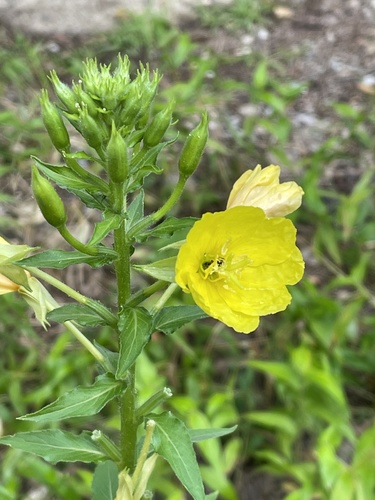
If you pass a tall weedy plant with lemon-yellow flowers that seem closed by day, come back at dusk to meet Common Evening Primrose (Oenothera biennis). Its blooms pop open in the evening, sometimes fast enough to watch, releasing a soft lemony scent into the dark.
What it looks like
This plant stands 1 to 1.5m tall on a stout, often reddish stem with long, narrow, slightly toothed leaves. The four-petaled flowers are about 3 to 5cm across, a clear bright yellow with a cross-shaped stigma in the center. Each flower lasts barely a day, so a tall stalk usually shows fresh open blooms near the top and wilting, orange-tinged old ones below.
When and where
- Season: Flowers from midsummer into early fall.
- Habitat: Roadsides, old fields, gravel lots, railway edges, and other open, disturbed sunny ground.
- Best time: Late evening or early morning, when the flowers are fully open.
Built for moths
Evening primrose opens at night to court night-flying moths, especially hawk moths that hover like tiny hummingbirds to sip its nectar. The pale yellow petals catch the last light and reflect ultraviolet patterns that moths can see, acting like landing lights. In return the moths carry pollen between flowers on long sticky threads. By the next hot afternoon the spent flowers wilt, their work already done.
Spot one this weekend
Common evening primrose is Uncommon, easy to miss by day when the flowers look shut. Find a tall yellow-tipped stalk along a sunny roadside, then return near sunset to watch the buds swell and snap open. A flashlight may even reveal a moth at work.