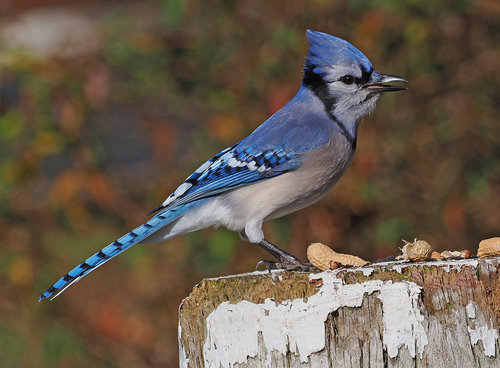
If a bold blue bird with a pointed crest lands on a branch and shouts a ringing "jay jay," you have met a Blue Jay (Cyanocitta cristata). Its blue back, black necklace, and crisp white face make it one of the easiest backyard birds to name.
What it looks like
Adults are about 28cm long with a tall crest they raise when excited and flatten when calm. The upperparts are bright blue barred with black and marked with white patches on the wings and tail, while the underside is pale gray. A thin black line crosses the throat like a necklace. Oddly, the blue is not a pigment at all but a trick of light bouncing off the feather structure.
When and where
- Season: Year round across the east, with some northern birds drifting south in fall.
- Habitat: Oak and mixed woods, leafy suburbs, park edges, and backyard feeders.
- Best time: Fall mornings, when jays are busy gathering and hiding acorns.
The oak planter
A single blue jay can cache thousands of acorns in a single autumn, carrying several at a time in a pouch in its throat and burying them one by one across the forest floor. Many are never dug back up, so they sprout into new oak trees the following spring. Blue jays are also skilled mimics and will copy the scream of a hawk, sometimes to scare other birds away from a feeder.
Spot one this weekend
Blue jays are Common wherever oaks and feeders meet. Listen for the loud "jay jay" call and watch for a flash of blue crossing a clearing. Scatter a few peanuts on a rail and a jay will often show up within minutes.