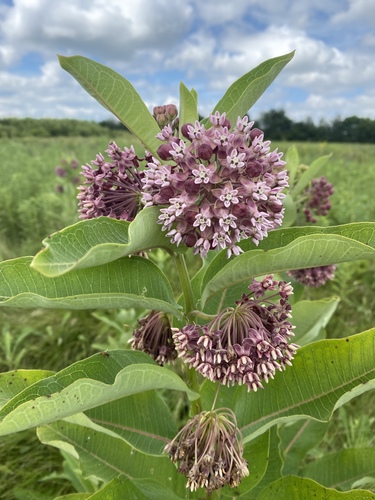
If you find a tall roadside plant topped with round clusters of dusky pink flowers that smell sweet in the summer heat, you have likely met Common Milkweed (Asclepias syriaca). Break a leaf and a thick white sap oozes out, giving the plant its name.
What it looks like
Plants stand 1 to 2 meters tall on a single sturdy stem lined with big oval leaves up to 20cm long. The leaves are pale green with a soft velvety underside and a thick central vein. Flowers grow in rounded clusters about 6cm across, each tiny bloom a star of pink to mauve. By fall the plant forms bumpy green pods that split open to release seeds on silky white parachutes.
When and where
- Season: Flowers from June to August, with pods opening in fall.
- Habitat: Roadsides, old fields, fence lines, and sunny open meadows.
- Best time: Warm summer afternoons, when the flowers are busy with insects.
The monarch's only nursery
Monarch butterflies lay their eggs on milkweed and nowhere else, because the caterpillars can eat only these leaves. The milky sap is mildly toxic, and the caterpillars store those toxins in their bodies, which makes them taste terrible to birds. That single link means no milkweed, no monarchs. Planting and protecting it along roadsides is one of the simplest ways to help the species.
Spot one this weekend
Common milkweed is Common along sunny roadsides and field edges. Look for the tall stem and pink flower balls in summer, or the split pods spilling silk in fall. Check the underside of the leaves and you may find a striped monarch caterpillar.