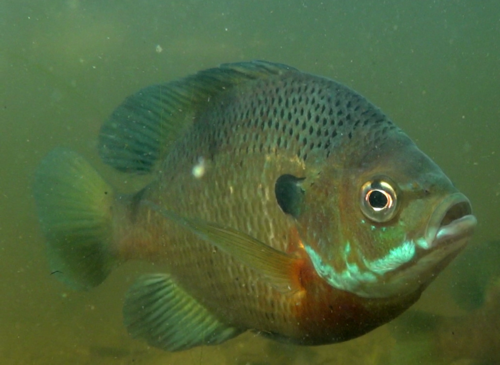
If you peer into a warm pond and see a round, flat fish the size of your palm hovering near the weeds, it is probably a Bluegill (Lepomis macrochirus). The dark flap sticking out behind its gill cover gives this common sunfish its clearest field mark.
What it looks like
Bluegills are about 15 to 20cm long with a deep, disk-shaped body flattened side to side. The back is olive green fading to a yellow or orange belly, often with faint vertical bars along the flanks. The face and gill area take on a blue sheen, and a solid black flap extends off the rear of the gill cover. Breeding males glow with especially bright orange chests.
When and where
- Season: Active spring through fall, most visible in the warm months.
- Habitat: Ponds, lake shallows, slow streams, and quiet weedy backwaters.
- Best time: Late spring and early summer, over the nesting beds in shallow water.
Fathers on the nest
In late spring, male bluegills sweep out shallow round nests in the pond bottom, often packed side by side in colonies like a honeycomb. After a female lays her eggs, the male stands guard alone, fanning fresh water over the eggs with his fins and chasing off anything that comes near, including fish many times his size. He keeps up the watch until the young hatch and swim off on their own.
Spot one this weekend
Bluegills are Common in almost any warm pond or lake edge. Look into clear shallows for saucer-shaped nests in early summer, each with a fish hovering above it. A tiny worm on a hook under a bobber is the classic way to meet one up close.