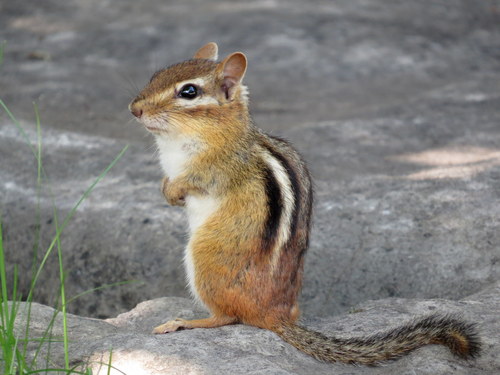
If a small striped animal darts across a stone wall with its tail held straight up, you have spotted an Eastern Chipmunk (Tamias striatus). The bold dark and light stripes down its back set it apart from any squirrel in the trees.
What it looks like
Eastern chipmunks are about 15cm long in the body with a furry tail adding several more. The coat is reddish brown with five dark stripes running down the back, separated by pale cream stripes, and a bright white stripe above and below each eye. The belly is white. Their most famous feature is a pair of stretchy cheek pouches that can balloon out when stuffed with food.
When and where
- Season: Active spring through fall, then dozing underground through winter.
- Habitat: Woodland floors, stone walls, brushy yard edges, and park undergrowth.
- Best time: Morning and late afternoon, when they scurry about gathering food.
Cheeks like grocery bags
A chipmunk's cheek pouches stretch to hold a startling amount, sometimes dozens of seeds or several acorns at once, letting it haul food back to an underground larder in one trip. Its burrow can run over three meters long with separate chambers for sleeping and storing food. Rather than a deep true hibernation, the chipmunk wakes every few days through winter to snack from its buried pantry.
Spot one this weekend
Eastern chipmunks are Common around wooded edges and old stone walls. Listen for a sharp repeated "chip" call and watch low along the ground, not up in the trees. Sit quietly near a rock pile and one will often pop out to investigate.