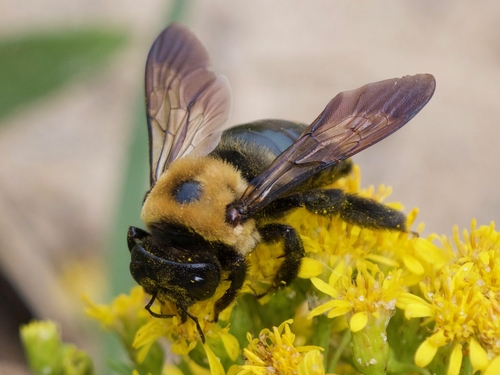
If a bee the size of your thumb hovers right in front of your face on the porch, that is almost always a male Eastern Carpenter Bee (Xylocopa virginica). He looks scary but cannot sting, and his shiny bare abdomen gives him away at a glance.
What it looks like
About 2 to 2.5 cm long, one of the biggest bees in the region. The body is heavy-bodied and black with a fuzzy yellow thorax. The key feature is the abdomen: smooth, shiny, and hairless black, almost like polished metal. Bumblebees look similar in size but have a fuzzy, striped rear. Males have a pale yellow patch on the face, females have an all-black face.
When and where
- Season: Spring through late summer, most active April to August.
- Habitat: Gardens, wooden decks, fences, eaves, and untreated softwood structures.
- Best time: Warm, sunny mornings near flowering plants or wooden railings.
How they carve their nests
Females chew nearly perfect round tunnels, about 1.5 cm wide, into bare wood using their strong jaws. The entrance looks machine-drilled. Inside, she carves a long gallery and packs each cell with a ball of pollen and nectar, lays an egg on it, then seals it with chewed wood pulp. The hovering males nearby are only guarding territory. They have no stinger at all, so the bluffing is pure theater.
Spot one this weekend
Eastern Carpenter Bees are Common. Check sunny wooden fences, deck rails, and porch beams for round holes with a little sawdust below. Stand still near flowers and a curious male may hover close to inspect you, a perfect, harmless photo chance.