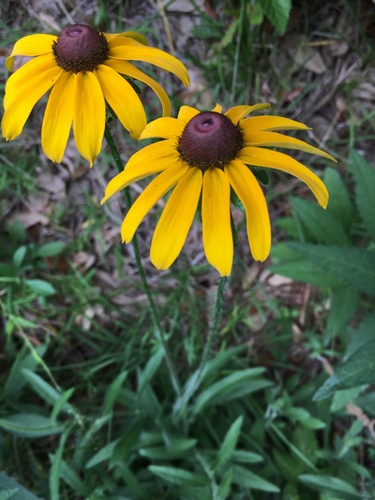
If a summer meadow glows with golden-yellow daisies, each with a raised dark brown button at the center, you are looking at Black-eyed Susan (Rudbeckia hirta). The dark eye against the bright petals makes it one of the most recognizable wildflowers of the eastern summer.
What it looks like
Plants grow 30 to 90cm tall on rough, hairy stems that feel bristly to the touch. Each flower head is about 7cm across, ringed by 10 to 20 golden-yellow petals around a domed center of deep brown to near black. The leaves are narrow, coarse, and covered in stiff hairs. A single plant often carries several blooms at once, so a patch reads as a wave of yellow.
When and where
- Season: Blooms from June through September.
- Habitat: Meadows, prairies, roadsides, and open fields with full sun.
- Best time: Sunny midsummer days, when bees crowd the dark centers.
A hidden target for bees
To our eyes the petals are plain yellow, but bees see ultraviolet light, and under it the base of each petal forms a dark ring around the center. This creates a bullseye that points pollinators straight to the pollen and nectar. The flower is guiding its visitors with a pattern we simply cannot see. After blooming, the dark centers dry into seed heads that feed goldfinches into fall.
Spot one this weekend
Black-eyed Susans are Common in sunny meadows and along country roads. Look for the golden petals circling a dark brown dome from midsummer on. Watch a flower for a moment and you will usually see a bee working the center.