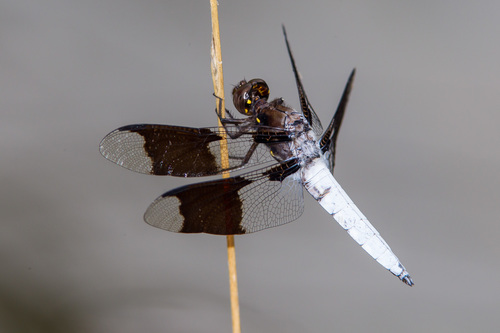
Near almost any still pond in summer you will see a stocky dragonfly with a startling chalk-white tail flying low over the water. That is a male Common Whitetail (Plathemis lydia), and the bright rear end is impossible to miss once you spot it.
What it looks like
About 4 to 4.8 cm long, with a thick, broad body rather than the slender shape of many dragonflies. Mature males have a powdery, chalky-white abdomen and each wing carries a single broad dark band across the middle. Females and young males are brown with a row of yellowish dashes down the sides and three dark patches on each wing. The eyes are dark and the body looks heavyset.
When and where
- Season: Late spring through early autumn, peaking in midsummer.
- Habitat: Edges of ponds, slow streams, ditches, and marshes, often perching on the ground or low twigs.
- Best time: Warm, sunny afternoons over open, still water.
Why the tail turns white
Young males are brown like females. As they mature, they develop a waxy white coating, called pruinosity, over the abdomen. Males use this bright tail in territorial displays, tilting it up toward rivals as a signal to back off. The whiter the tail, the more dominant the male, so it works like a flag claiming the best stretch of pond shoreline.
Spot one this weekend
Common Whitetails are Common. Walk to any pond or slow stream edge on a sunny day and scan low over the water and bare ground. Males often perch on the same spot repeatedly, so if one flies off, wait a minute and it usually returns to the exact same twig.