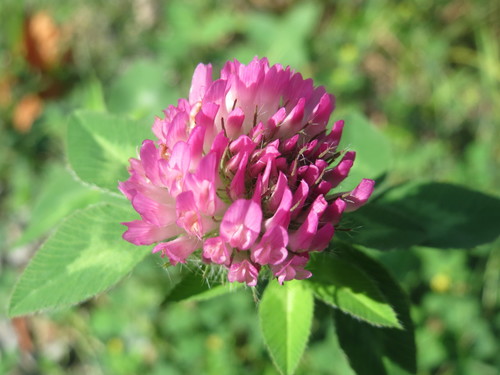
If a tall stem with a round pink puffball flower is waving above the grass in a sunny field, you found Red Clover (Trifolium pratense). It is one of the most common roadside wildflowers across the US and one of the most important nectar plants for bumblebees in early summer.
What it looks like
The plant stands 30 to 60cm tall with hairy stems. Each leaf has three oval leaflets, and most leaflets carry a pale crescent or V-shaped mark across the middle, which is the easiest way to tell red clover from its smaller cousin white clover. The flower head is a round cluster, about 2 to 3cm wide, made of dozens of tiny tubular flowers in soft pink to magenta. Two small leaves sit right under each flower head like a collar.
When and where
- Season: May through September across most of the US.
- Habitat: Roadside ditches, hay fields, pasture edges, mowed park edges, neglected lawns.
- Best time: Mid morning on a sunny day, when bumblebees are most active on the flowers.
A bumblebee specialist
The tube-shaped flowers of red clover are too deep for honeybees to reach the nectar at the bottom, but bumblebees have longer tongues and can dive all the way in. On a warm afternoon you can often count five or six bumblebees on a single clover patch. The plant is also a nitrogen fixer, meaning bacteria in its root nodules pull nitrogen out of the air and turn it into fertilizer for the soil. Farmers have planted red clover for this reason for over two thousand years.
Spot one this weekend
Red clover is Common in every US state. Walk along any country road, park edge, or unmowed strip and look for the pink puffballs about knee height. A patient kid can hold a flower head still and watch a bumblebee work each tiny floret one by one. Try gently pulling one of the small tubular florets out of the head and tasting the drop of nectar at the base. Sweet, mild, and a tiny taste of summer.