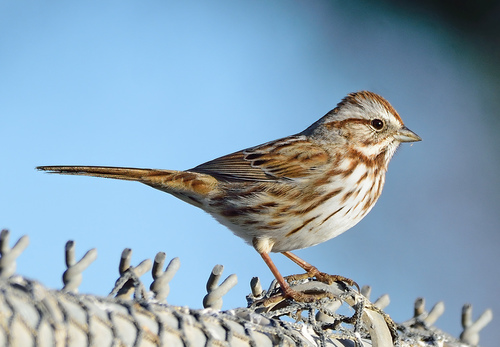
If you hear a long, complex, melodic song coming from a brush pile or a low shrub, even in the middle of a parking lot, look for a small streaky brown bird perched at the top. That is a Song Sparrow (Melospiza melodia), one of the most widespread songbirds in North America.
What it looks like
Song Sparrows are about 15 cm long with brown and gray streaks all over the back and a heavily streaked chest that usually has a single dark spot right in the center. The face shows a gray stripe over the eye and a strong brown mustache mark. The tail is long and rounded, and they often pump it downward when they fly. Males and females look the same.
When and where
- Season: Year-round across most of the US and southern Canada.
- Habitat: Brushy field edges, marsh borders, suburban yards with shrubs, community garden fences.
- Best time: Spring mornings, when males sing from exposed perches.
Local song dialects
Song Sparrows are famous among bird researchers for one reason: their songs vary by region, the way human accents do. A young male learns his song from the adult males nearby in his first summer, which means the version you hear in Brooklyn sounds different from the version in Vermont. Each male holds a small repertoire of 5 to 13 song types and cycles through them all day during the breeding season.
Spot one this weekend
Song Sparrows are Common in almost every kind of edge habitat. Look low rather than high: they prefer perches around 1 to 3 meters off the ground, never the treetops. If you slow down at a brushy fence line or a weedy ditch and stay still for a minute, one will almost always pop up to check on you.