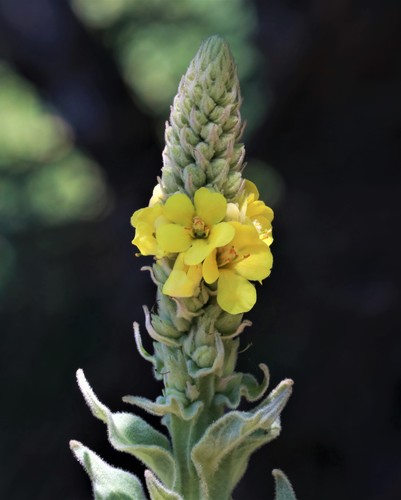
If you walk along a dry roadside in summer and see a tall yellow flower spike rising two meters out of a rosette of huge fuzzy gray-green leaves, that is Common Mullein (Verbascum thapsus). It looks like nothing else, and once kids touch the leaves they remember it forever.
What it looks like
In the first year, mullein grows as a low rosette of large oval leaves on the ground, each one 15 to 30 cm long and covered in dense soft hairs that feel like felt. In the second year it shoots up a single tall stalk, often 1.5 to 2 meters high, topped with a thick spike of small yellow five-petaled flowers. The flowers open a few at a time over many weeks rather than all at once. The whole plant has a silvery gray-green look from a distance.
When and where
- Season: Yellow flowers appear from June through September.
- Habitat: Dry sunny roadsides, abandoned lots, gravel parking edges, sandy fields, railroad embankments.
- Best time: Late morning, when flowers are open and bees are visiting.
A plant with many old uses
The soft leaves of mullein gave it nicknames like flannel leaf, bunny ears, and yes, in some places, cowboy toilet paper. Settlers in early America made tea from the leaves and flowers for coughs, and dried flower stalks were dipped in tallow and used as torches. The seeds, however, are mildly toxic to fish, which is why mullein is on watch lists near sensitive waterways. The plant is not native to North America, it arrived from Europe in the 1700s and spread quickly along disturbed ground.
Spot one this weekend
Common Mullein is Common almost everywhere with dry sun. Once you know the tall yellow spike, you will start seeing them on every highway shoulder. Let your child touch one of the lower rosette leaves, gently, so the leaf stays on the plant. The texture surprises every first-timer.