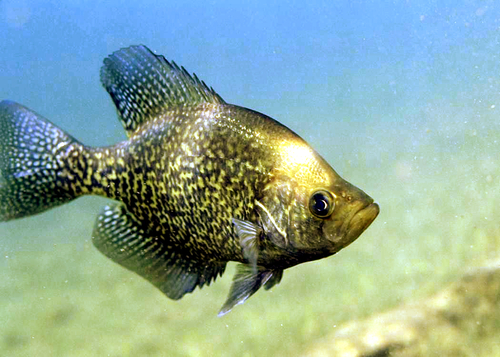
If you peer off a wooden dock on a slow pond or lake in summer and see a tall flat silver fish hovering in the shadows below, you may be watching a Black Crappie (Pomoxis nigromaculatus). They are one of the most popular panfish across the central and eastern US, and one of the easier fish to actually see from above.
What it looks like
Adults are usually 20 to 30 cm long, with a strongly flattened side-to-side body that looks almost coin-shaped from the front. The base color is silvery to pale gold with scattered irregular dark blotches across the sides, which is the trait that separates them from the closely related White Crappie's vertical bars. The dorsal and anal fins are nearly the same size, large, and speckled. The mouth is large for such a flat fish, with a soft thin lip that anglers call "papermouth."
When and where
- Season: Active year-round, easiest to see in May and June around spawning beds.
- Habitat: Slow lakes, ponds, reservoirs, slow river backwaters, especially near submerged brush, fallen trees, and dock pilings.
- Best time: Early morning and the last hour before sunset.
A fish that builds nests in colonies
Black Crappies are nest builders. In spring when water hits around 16 to 20 C, males fan out shallow circular nests in sand or fine gravel near cover, often dozens of nests in tight clusters. After a female lays eggs, the male guards the nest aggressively against any intruder, including small turtles and other crappies. Outside spawning season, they form loose schools that follow shad and small minnows around the lake, suspending in mid-water rather than holding on the bottom.
Spot one this weekend
Black Crappies are Common in any pond or lake with structure. Walk to the end of a public fishing pier and look straight down into the shade beneath the planks. The flat silver shape with dark speckles, hovering motionless near a piling, is your fish. Bring a bobber and a small minnow if you want to actually catch one.