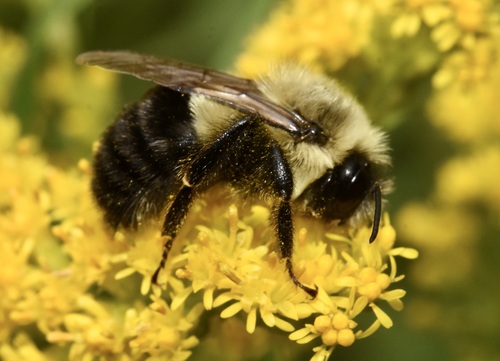
If a big fuzzy bee with bold black and yellow stripes lands on a flower in your yard and barely seems to notice you, you have met a Common Eastern Bumble Bee (Bombus impatiens). They are the most abundant bumble bee in eastern North America and one of the most important pollinators for backyard tomatoes, blueberries, and squash.
What it looks like
Workers are 8 to 16mm long with a thick fuzzy coat that looks like short velvet. The body is black with a single bright yellow band across the thorax and a yellow band on the first segment of the abdomen. The rest of the abdomen is solid black. Queens are noticeably larger, up to 22mm, with the same color pattern. Their wings are smoky brown and faintly veined.
When and where
- Season: Queens emerge in early April, workers from May through October, new queens and males in late summer.
- Habitat: Suburban gardens, parks, meadows, farms, forest edges. Nests in old rodent burrows, compost piles, or under thick grass.
- Best time: Mid-morning when the air warms up. They start flying earlier and at cooler temperatures than honey bees because they can shiver their flight muscles to warm up.
The 400Hz buzz that shakes pollen out
Tomato, blueberry, and eggplant flowers hold their pollen inside small tubes that only open if vibrated at exactly the right frequency. Honey bees cannot do it. Bumble bees can. A bumble bee grabs the flower, unhooks her wings from her flight muscles, and vibrates her body at about 400Hz, which is roughly the pitch of middle C. The pollen shakes loose in a small puff. The behavior is called buzz pollination and you can hear it if you stand still near a tomato plant.
Spot one this weekend
Common eastern bumble bees are Common throughout the eastern half of North America. Stand near any patch of clover, bee balm, or coneflower on a sunny morning. Within minutes one will land on a flower less than a meter from you. They almost never sting unless you grab one, so a phone camera 10cm away is totally safe.