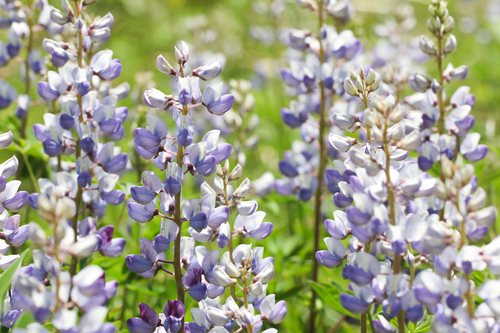
If you walk past a sandy roadside in May and see a row of bright blue-purple flower spikes standing knee-high, you've found Wild Lupine (Lupinus perennis). It's the only native lupine east of the Mississippi and the host plant for the endangered Karner blue butterfly.
What it looks like
Wild lupine grows in a clumping rosette with palmate leaves that look like little blue-green hands, usually 7 to 11 leaflets fanning out from a single stem. The flower spike rises 30 to 60 centimeters above the leaves with 20 to 50 pea-shaped flowers, each about 1.5cm long. Color runs from deep violet to sky blue, with the occasional white or pink mixed in. The seed pods that follow are fuzzy and split open with an audible pop on hot afternoons, flinging seeds a meter or two away.
When and where
- Season: Mid-May through mid-June for flowers. Leaves visible from spring through early fall.
- Habitat: Sandy soil, pine barrens, open meadows, roadside edges, and powerline cuts. Needs full sun and well-drained ground.
- Best time: Late morning, when the sun lights up the spikes from the side and the blue almost glows.
Why it only grows in poor soil
Most wildflowers struggle in sandy, nutrient-poor soil but lupine thrives there because it pulls nitrogen out of the air through bacteria in its roots and stores it in tiny root nodules. That means lupine actually improves the soil for other plants over time. The downside is that as the soil gets richer, taller plants move in and shade the lupine out, so it depends on disturbance like fire or sandy openings to keep its patch.
Spot one this weekend
Wild lupine is Uncommon because it needs that specific sandy, sunny habitat. The easiest places to find it are pine barrens in the northeast, open sand prairies in the Midwest, and the edges of powerline cuts where the soil stays disturbed. Look for the rosette of palmate leaves first, then scan up for the spike. If you spot a small dusty blue butterfly hovering nearby, that might be a Karner.