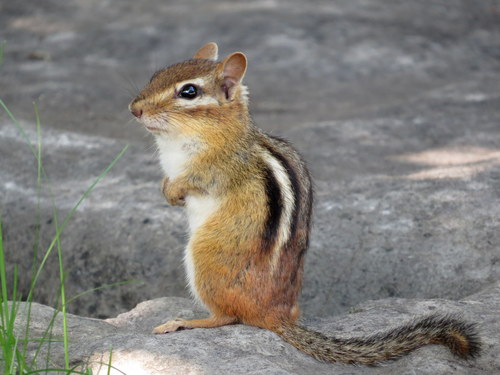
If a tiny striped rodent darts across your trail and disappears under a log before you can react, you just met an Eastern Chipmunk (Tamias striatus). They are the smallest member of the squirrel family in eastern North America, and they live almost everywhere humans do.
What it looks like
Adult chipmunks are about 13cm long with another 8cm of tail. The signature look is five dark stripes running down a reddish-brown back, with two white stripes flanking the dark ones. The face is the easiest tell: a white stripe above and below the eye, framed by two more dark stripes. Their cheek pouches can stretch to triple the size of their head when stuffed with seeds.
When and where
- Season: Spring through fall. They go into torpor in winter and you rarely see them December through February.
- Habitat: Deciduous forest edges, suburban yards, stone walls, woodpiles, parks with mature oak or beech trees.
- Best time: Mid-morning, especially right after sunrise on a cool day. They warm up on logs and rocks.
The underground city
A single chipmunk burrow can run 9 meters long with multiple chambers, including a sleeping room, food storage, and even a separate latrine. The entrance is usually only 5cm wide and almost invisible because they carry the dirt away in their cheek pouches and dump it far from the hole. One chipmunk can stash up to 8 pounds of acorns and seeds for winter.
Spot one this weekend
Eastern chipmunks are Common across most of the eastern US and southern Canada. Walk slowly along a stone wall or the base of a big oak in the morning and listen for a sharp, repeated "chip-chip-chip" call. Have your phone ready before you spot one, because the second they see you, they're gone in under a second.